Expanded Scan Volume
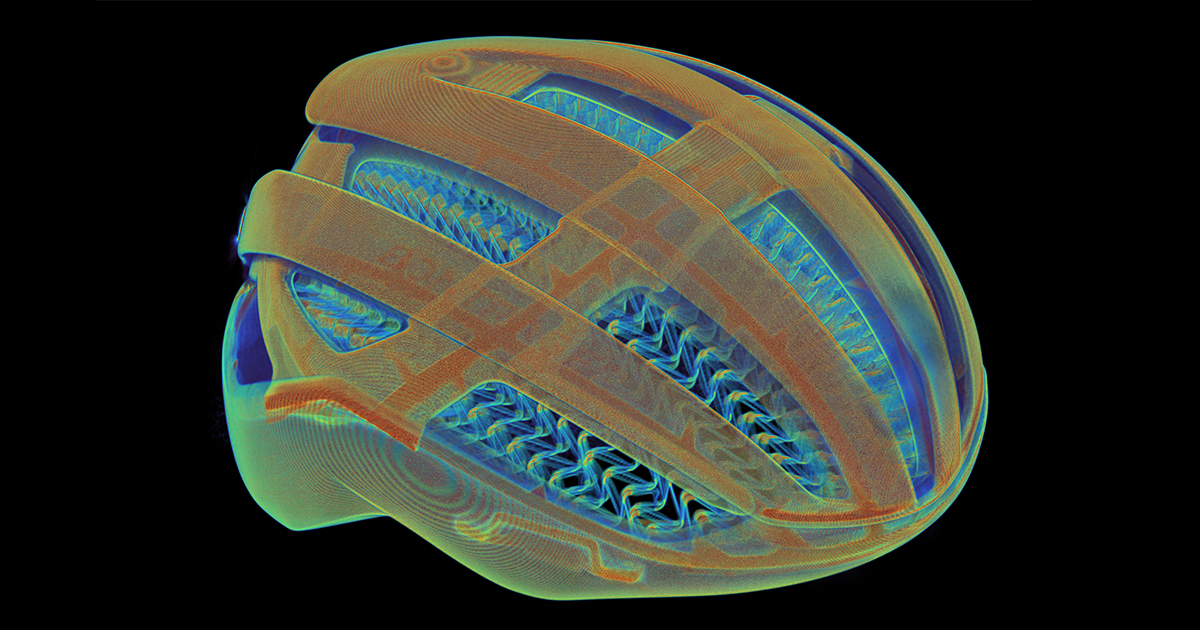
Expanded Scan Volume broadens the Field of View (FOV) on your scanner, enabling you to inspect parts with up to 85% larger volumes and up to 50% bigger diameter than before or to increase magnification for improved magnification. Similar to panorama mode on your phone’s camera, this acquisition mode allows you to capture more data within the frame, providing a comprehensive view of your products.How to use the Expanded Scan Volume Module
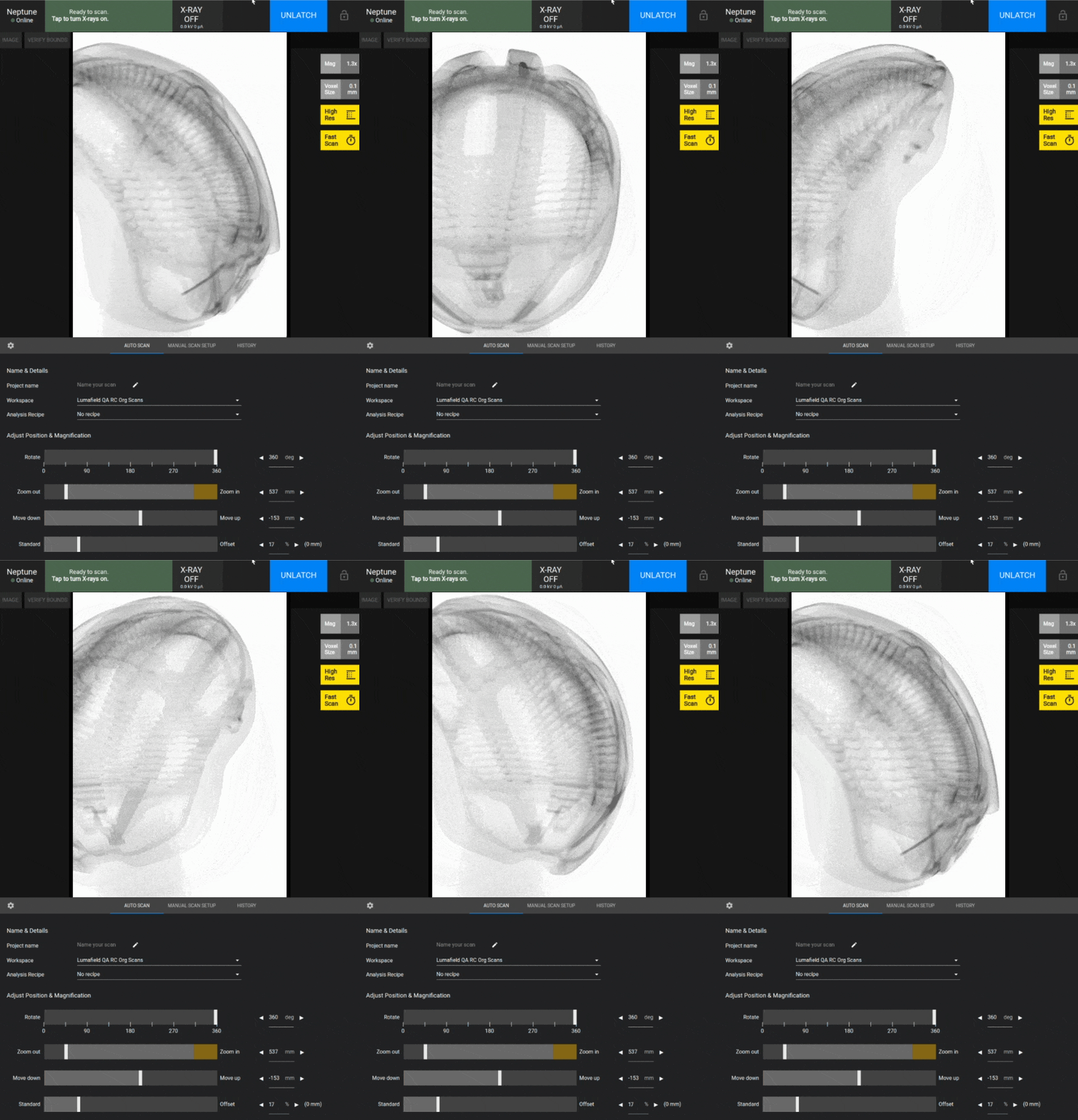
When this module is enabled, the scanner software will display a slider that allows for the selection of offset scanning. As the chosen offset value increases, the motion axis will move further toward the door. Offset value can range from 0% (standard scanning) to 100% (our maximum recommendation). A higher offset enables a larger scan volume or higher magnification for a given part or region of interest.Note that larger offsets will introduce the potential for more scan artifacts.
Helical Scanning
Helical Scanning extends the scannable volume along the vertical (Z) axis of your scanner, enabling you to inspect taller parts, run batch scanning workflows, or use greater magnification over a larger region. The scanner acquires data while moving vertically through multiple rotations, then reconstructs a single volume. This mode is well-suited when you need more vertical coverage or want to reduce cone beam artifact compared to standard acquisition.When to use Helical Scanning
Consider Helical Scanning when you need:
- Increased scannable volume: Parts or regions of interest that exceed the standard vertical Field of View (FOV)
- Greater magnification: Higher magnification over a larger Z extent than standard scanning allows
- Reduced cone beam artifacts: Smoother results in regions where cone beam effects are a concern
Trade-offs: Scan time increases. Reconstructions use more data and compute than standard scans. Helical is generally not recommended when none of the above benefits are required.How to execute a Helical Scan
When the Helical Scan Module is enabled, perform the following steps on the scanner:
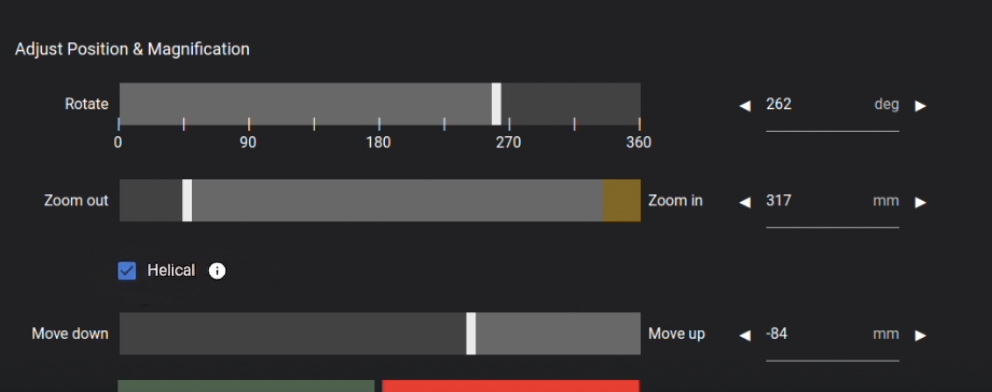
- Enable Helical: Check the “Helical” scanning option.
Note: Enabling helical will disable offset scanning.
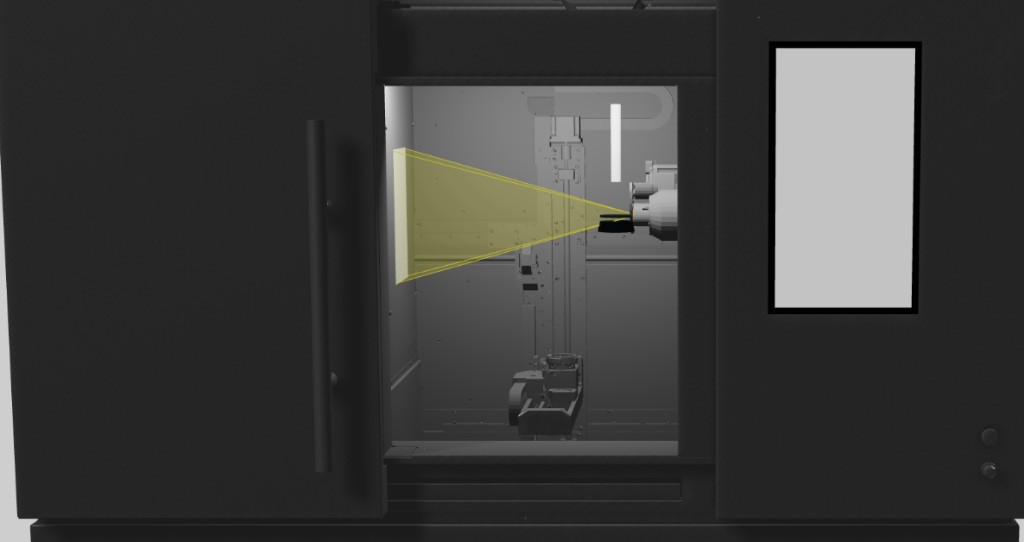
- Open door, position stage: Move the stage to maximum height (avoid contact with the roof), then to maximum zoom (avoid contact with the source). Close the door.
- Set magnification: Move to the desired magnification while ensuring entire part fits in the Field of View (FOV).
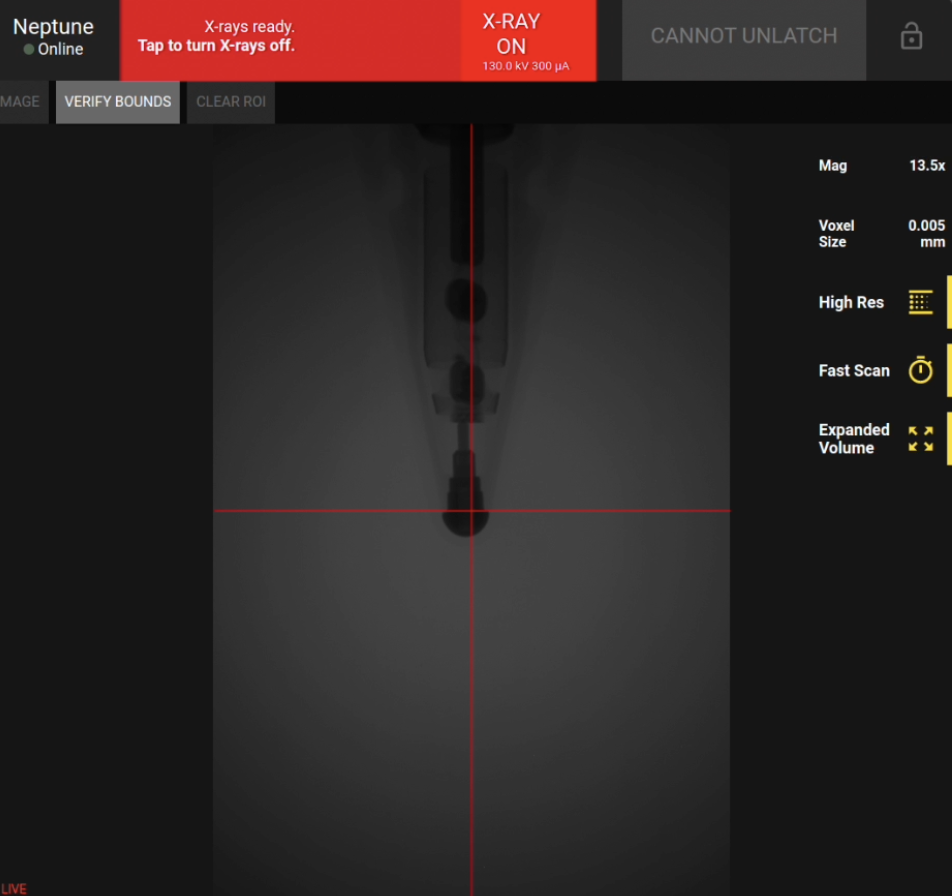
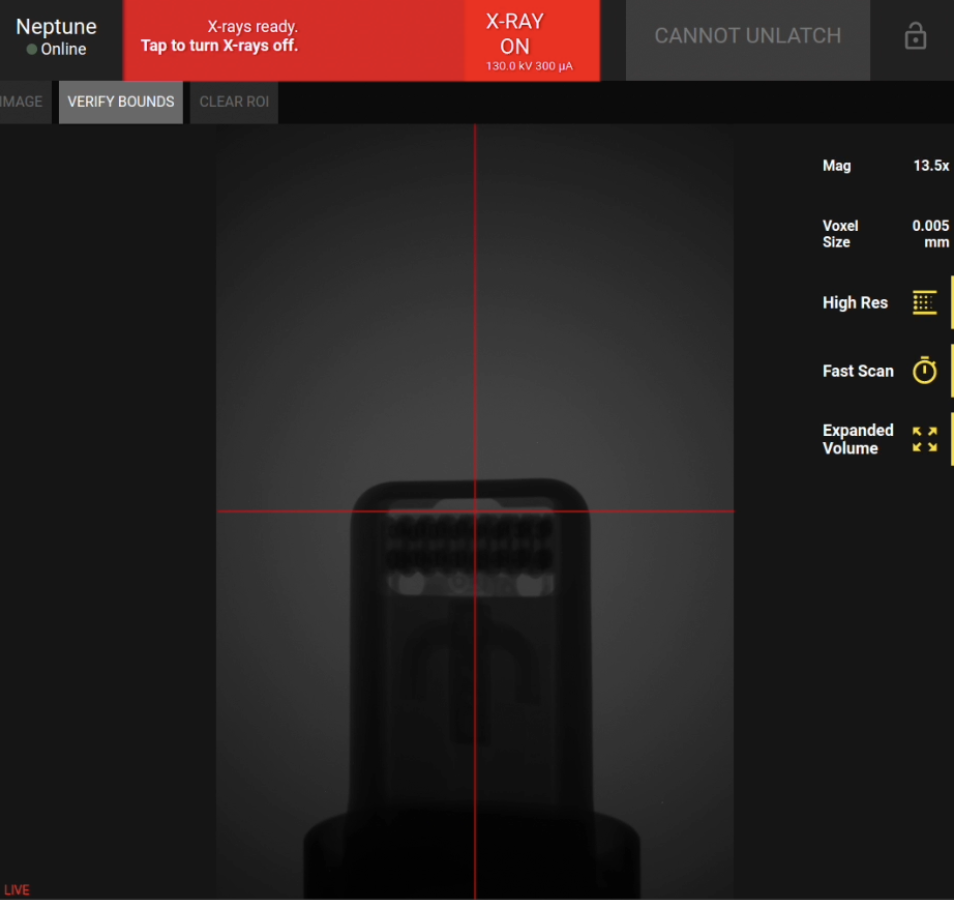
- Set top boundary: Move vertically to set the top boundary of the scan so the bottom of the part is vertically centered in the FOV.
- Set bottom boundary: Move down to set the bottom boundary of the scan so the top of the part is vertically centered in the FOV.
- Run the scan: Select your scan time and start the scan.
Note: When zoom is adjusted, vertical boundaries must be reset. Re-establish top and bottom bounds after any zoom change.
Tips for best results
- Vertical travel: In order to be included in the reconstruction, a feature must travel through at least 10% of the vertical FOV; 50% is recommended to mitigate cone beam artifact. The system performs multiple rotations per vertical FOV.
- Projections: There will be a warning if the scan time selected does not provide a sufficient number of projections for a high quality scan.
- Tuning: Perform tuning on the densest section or primary region of interest for more consistent results.
Limitations and considerations
- Rotary stage: The rotary stage may be visible in the Field of View (FOV) at the scan top boundary if necessary. To avoid interference with reconstruction, fixture your part with enough clearance above the rotary stage so that the stage and the part do not overlap in the projections.
- Vertical FOV: When a feature does not travel through a sufficiently large region of the FOV, limited-angle artifacts can appear.
- Reconstruction size and time: Helical reconstructions can be very large (e.g., on the order of 1 TB in some cases) and take longer to process.
- Compatibility: Helical Scanning is included in the Software Platform Subscription.